|
|
|
"You got mail," Raymond said, dropping a letter on
the counter in front of Elvis. No letters since Bangkok, surprise, and
he took it up. "Girlfriend?" he said.
|
|
|
| Melanie watched him be engulfed in
the sun, dust, odorous air, saw his arms and body tense; suddenly he crossed
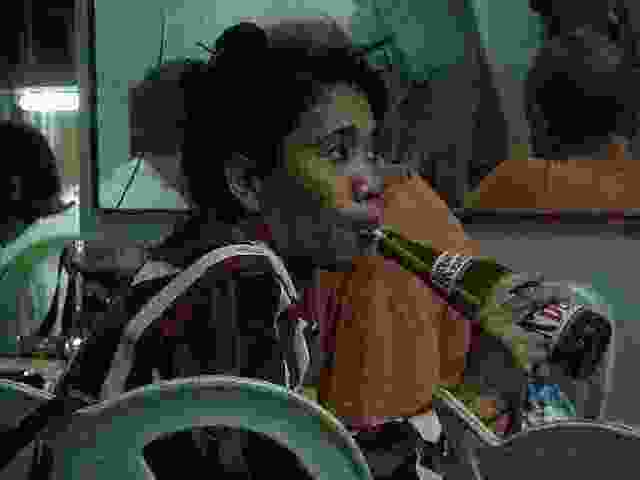
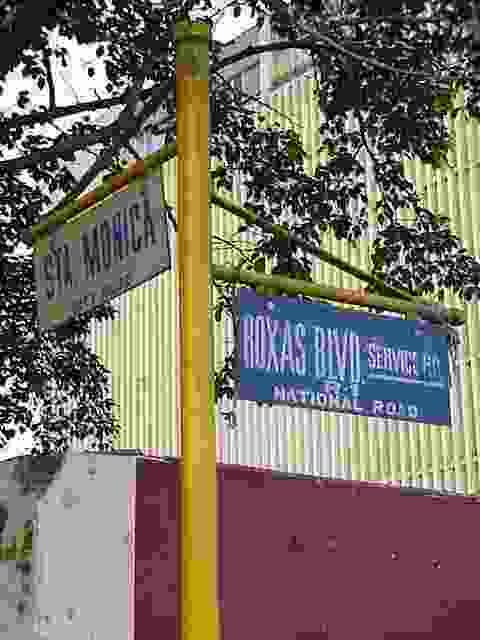
and was beside her, kissing cool her cheek, touching her fingers. "Sleep well?" he said. She yawned. "You, huh!" she pouted, "Drinking again!" "Walang problema," he said. No problem. She started walking, up del Pilar, vaguely towards the bay, and took the bottle of beer in his hand. Occassionally, her arm touched his and his hair tickled lightly into her brown, salty skin that he felt when they touched like this, neither drawing away, and this accidental touching they knew an intimacy, a willingness to drink each other's sweat, a power to ignore all the warnings of knowledge and cowardly science, a hint of their ability to live in dreams, to eat invisible fruits, drink weightless fluids, breathe symbols alone, and neverthelss shit solidly in days that rolled like dice on the dirty street; but something bothered him and it made him silent. "God damn," Melanie said, "this beer too fuckeng warm!" She walked with a cute, sharp snapping of her buttocks left-right - . They passed the Bamboo Garden restaurant, open to the street. Amidst the plastic flowers and rubber geckos on the walls, a few foreigners having breakfast. "What you reading in Raymond's?" she said. "A letter from my mother." "She want you to come home?" "No. Just Hello, What you doing." "Hoy, Melanie!" a friend greeted. Melanie raised her hand. "Hoy, Winnie!" Elvis said. They crossed Santa Monica street. An old foreigner turned to leer at her. "He looking at my ass?" "You know him?" "I don't like him." Then, a few steps farther, they reached the small park, really only a plot with bushes and a dried-up fountain. Under the single acacia tree, mildly shadowed by its leaves, was a bench of rough concrete. They stopped there. Elvis was quiet. "Hey, you mad about the old man?" Melanie said. He was staring at her. She crossed her legs. "Babuy," she said. Pig. "Fuck him," Elvis said. "What's the problem?" she said. He felt at his pocket, then dropped his hand helplessly. "I have to make money," he said. "Oh, yeah? Why only now?" she said, suspicious. But he was feeling his pocket again; he caught himself, dropped the hand to his thigh, because there was nothing there. He was puzzled by a sudden obsession, linked to his pride. "I have to make money!" Melanie touched his hand. He thought about the dumpyard and cringed. It was there, just up the street. The weeds, the insects, the smells. Bad, dirty, desolation. It seemed impossible that he liked this life ... and yet, there was a dreaminess that excited him. A freedom carnal in its immediacy. He knew not to question too deeply, or round/round a bottomless whirlpool he'd go. Images were sour, uncomfortable, almost invisible: the cardboard he slept on, the garbage, the dog sniffing along the yard, Carina's face when sex ate at her, the spider bobbing on the edge of a flower ... obsessive. Elvis, suddenly, frowned at his dirty fingernails. "What you want?" he heard Melanie, "What?" and, quickly, she glanced at him. Did she see it? Did she see the truth? he wondered; or merely his confusion. "I told you," he said. He got up and started walking in the direction of Raymond's. At the corner he stopped and his thinking became audible. He muttered and cursed about the predicament he thought he was in. He seemed paralyzed, wanting to run across the street, yet something pressing him back. Melanie shied away from him. "You crazy!" she said. The traffic's dust buffeted up like a desert. Across, the owner of a cigarette stand threw water on the sidewalk dust. Smells wrestled in the air - frying fish, mango, coconut, steaming rice, cheap perfume, whiffs of iodine off the bay, fresh, oceanic, sampaguita flower, sweet like childhood, and sweat, passing on a laborer's shoulder. "Hopeless," Elvis said and, suddenly, turned back. "Hoy!" Melanie shouted, "Where you going?" He threw up his arms. "Hoy!"" He wouldn't stop. "Loco ka," she said. She didn't chase after him. The traffic paused. People crossed the street. "Is your mother sick - ?" she said. He was too far to hear. "Hoy!" she said. Again dust boiled around her. "I love you too!" she said. She felt a kind of shadow pass over her, dry and oppressing, and important. She hated him. It was the same with loving him, hating him. Like a coin tumbling inside of her, going gold, going mud, diamond, fart, sun, puzzled scream, a poor, speechless princess. She crossed the street, away from him, and looked back once. Saw the top of his tawny head bobbing away over the others, the mostly short brown people. She felt the surge, the surprise of love again, the familiar pang of want, the head going away like a throne of delight, second by second, inch by inch; but he was going nowhere, she thought, going just up the street, the crazy white. |
|
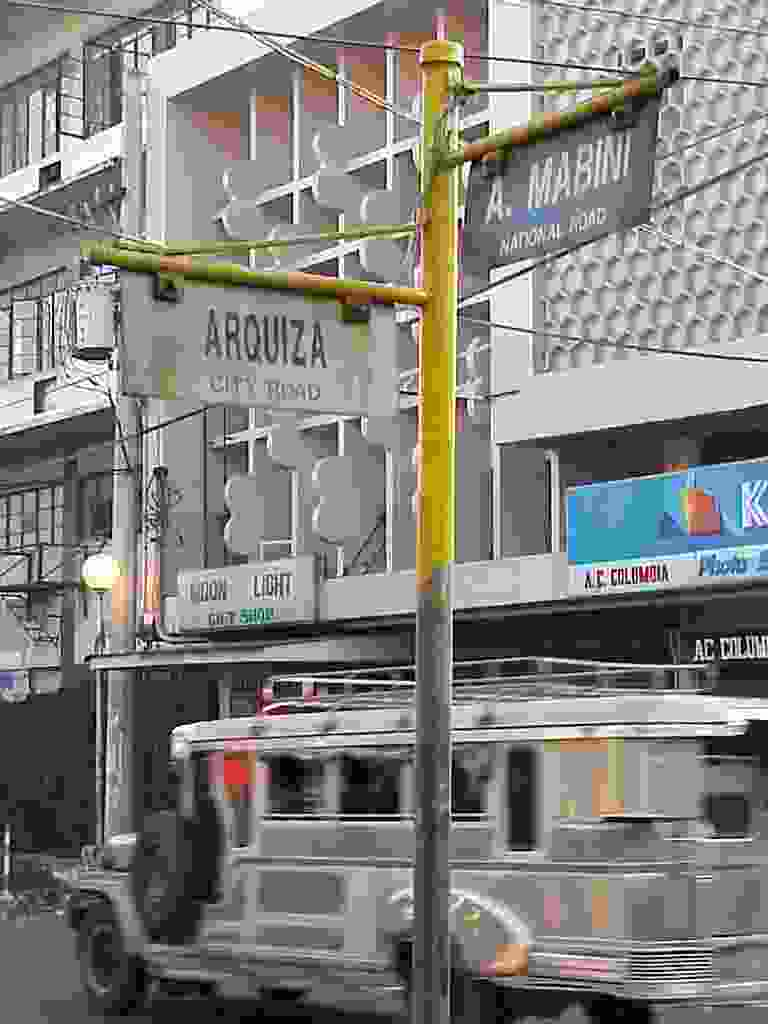
Del Pilar dead-ended on T.M. Kalaw street, just after
United Nations Avenue, the Hilton Hotel, and JolliBee, the Filipino burger
chain. Down any side street to the left led to Manila Bay fronting the
Roxas Boulevard Esplanade, formerly Dewey Boulevard named after the American
Naval officer who bombarded an old Spanish Manila in 1898. Shops lined
del Pilar and side streets, offering antiques, Spanish lace, fine Tagalog
shirts of pineapple fiber, and also the tourist handicrafts of colorful
parrots, napkin rings, plates of monkeypod wood; shops almost themselves
antiques, floors of shiny wood, and elegant paneling, whispering fans,
fly swatters gentle on the glass displays, snoring clocks; lightskinned
and infinitely courteous, the sales ladies lived in another time, waiting
for the rare customer to enter, or an old friend to buy an inexpensive
gift; ladies soft and harmless, shuffling in a space of lustrous ticks-and-tocks
and of dust drifting over hardwood toys. They were there amidst the Go-gos
and the bars, hotels and barbeque stands, warming in the afternoon light
and the falling leaves, the yellow mimosa, the acacia, the heart-shaped
leaves that tumbled so effortlessly.
|